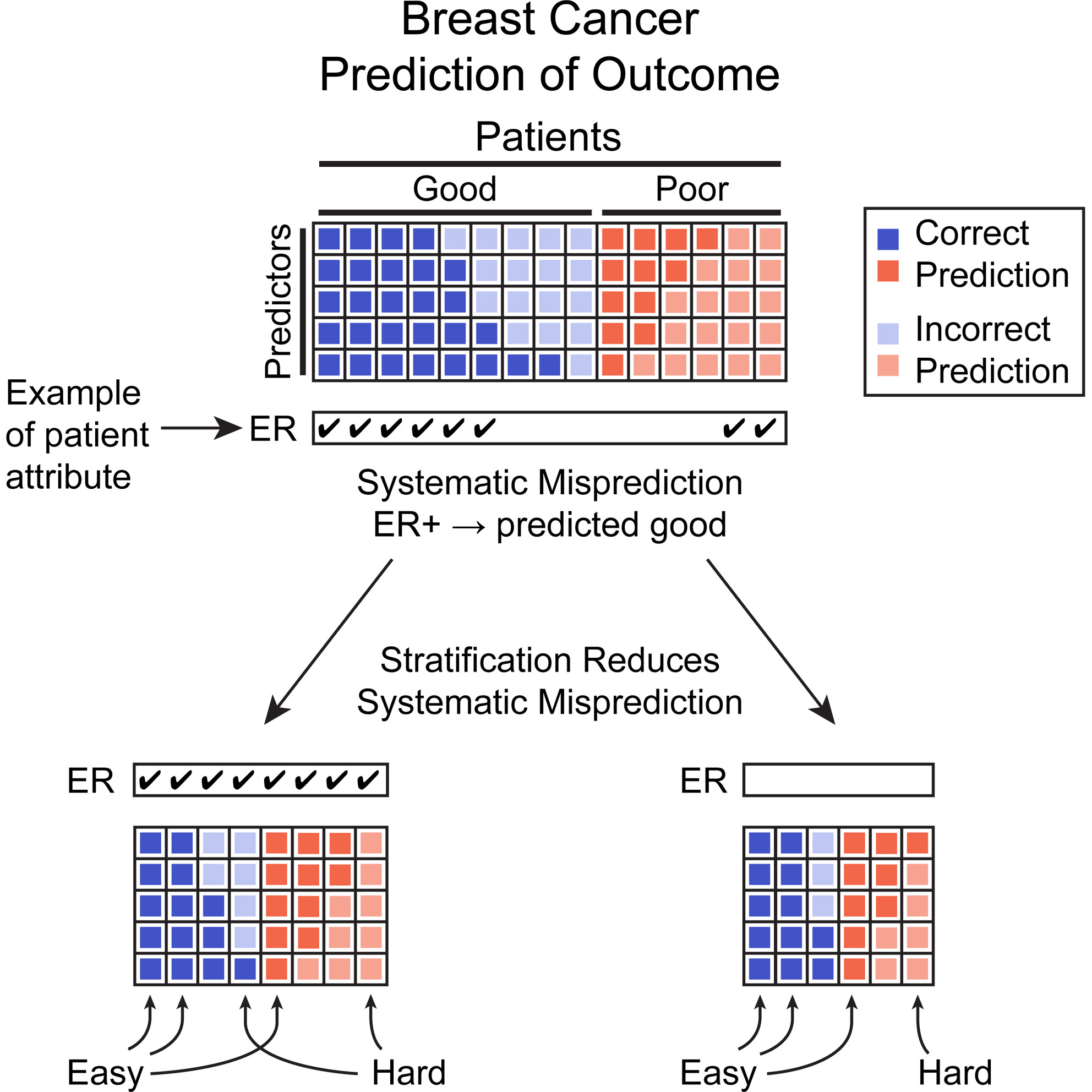
Breast carcinoma (BC) has been extensively profiled by high-throughput technologies for over a decade, and broadly speaking, these studies can be grouped into those that seek to identify patient subtypes (studies of heterogeneity) or those that seek to identify gene signatures with prognostic or predictive capacity. The sheer number of reported signatures has led to speculation that everything is prognostic in BC. Here, we show that this ubiquity is an apparition caused by a poor understanding of the interrelatedness between subtype and the molecular determinants of prognosis. Our approach constructively shows how to avoid confounding due to a patient’s subtype, clinicopathological profile, or treatment profile. The approach identifies patients who are predicted to have good outcome at time of diagnosis by all available clinical and molecular markers but who experience a distant metastasis within 5 years. These inherently difficult patients (~7% of BC) are prioritized for investigations of intratumoral heterogeneity.
§ Tumor × Host · 2014
The prognostic ease and difficulty of invasive breast carcinoma.
Ali Tofigh, Matthew Suderman, Eric R Paquet, Julie Livingstone, Nicholas Bertos, Sadiq M Saleh, Hong Zhao, Margarita Souleimanova, Sean Cory, Robert Lesurf, Solmaz Shahalizadeh, Norberto Garcia Lopez, Yasser Riazalhosseini, Atilla Omeroglu, Josie Ursini-Siegel, Morag Park, Vanessa Dumeaux, Michael Hallett
Cell reports 9, 129-142 (2014)
DOI ↗