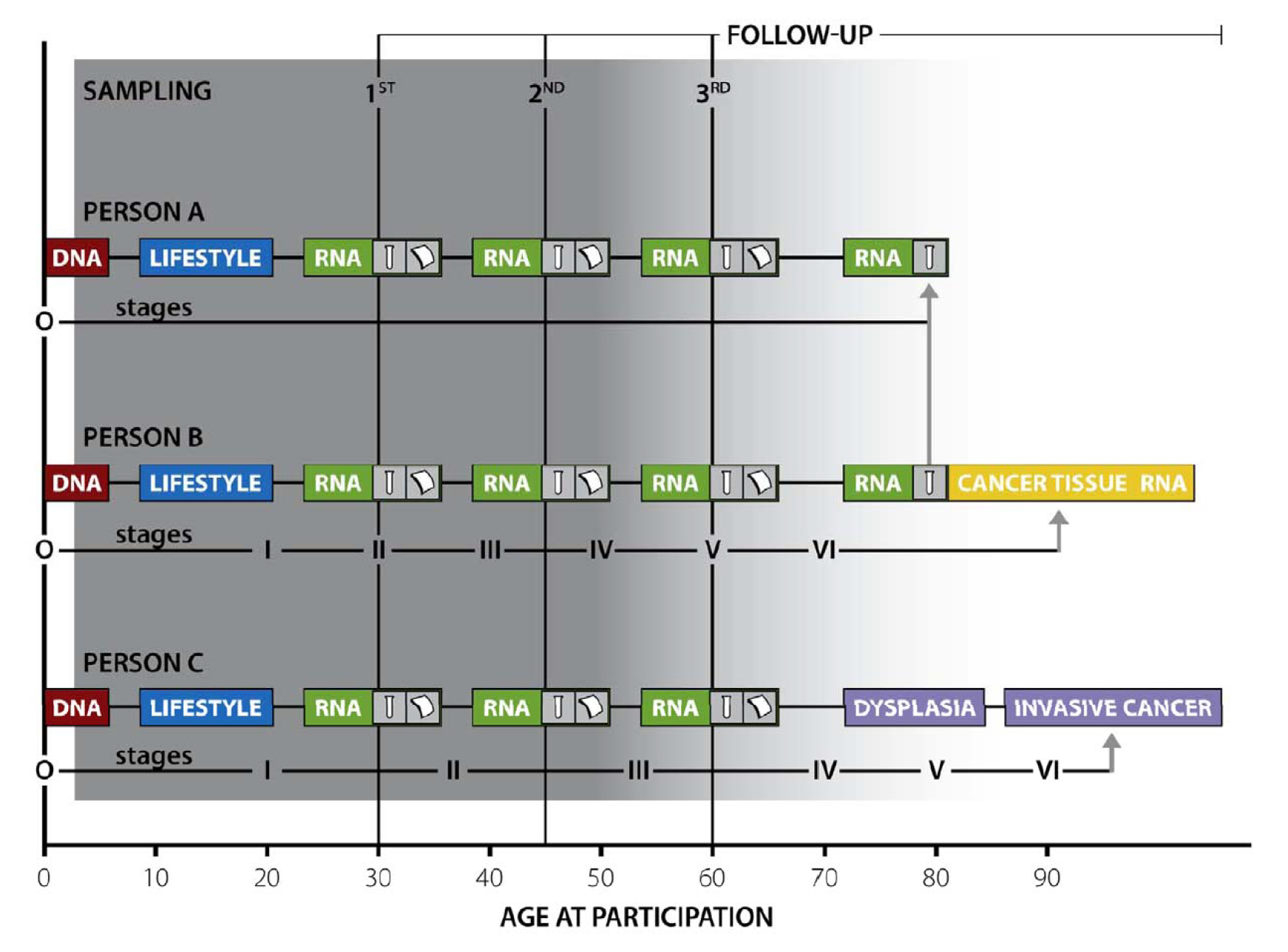
Advances in molecular technologies challenge the different concepts of causality in biology, epidemiology and multistage mathematical models. The lack of integration of the different aspects of causality into a common framework could postpone our attempts to build a human causal model of carcinogenesis. We present here some aspects of differences in methodology, terminology and traditions between the scientific disciplines and propose a research strategy using functional analyses of the transcriptome and epigenetics to illuminate causality in complex biological systems. Overcoming the challenges of biological material collection suitable for such analyses into a prospective design, this could give unique opportunities for verification of mechanistic information from basic biological research in a human model system. The ultimate goal is to obtain a dynamic causal description of the different carcinogenesis stages. The success of this novel approach depends on the biological relationship between the gene expression of the somatic driver mutations or co-expressed genes in tumours and the gene expressions mirrored in peripheral blood along the different stages of carcinogenesis. The use of gene expression profiles and epigenetics could produce a functional concept of causality to explain the human multistage carcinogenic process.
§ Epidemiology · 2010
Towards a more functional concept of causality in cancer research.
Eiliv Lund, Vanessa Dumeaux
International journal of molecular epidemiology and genetics 1, 124-33 (2010)
PDF ↗