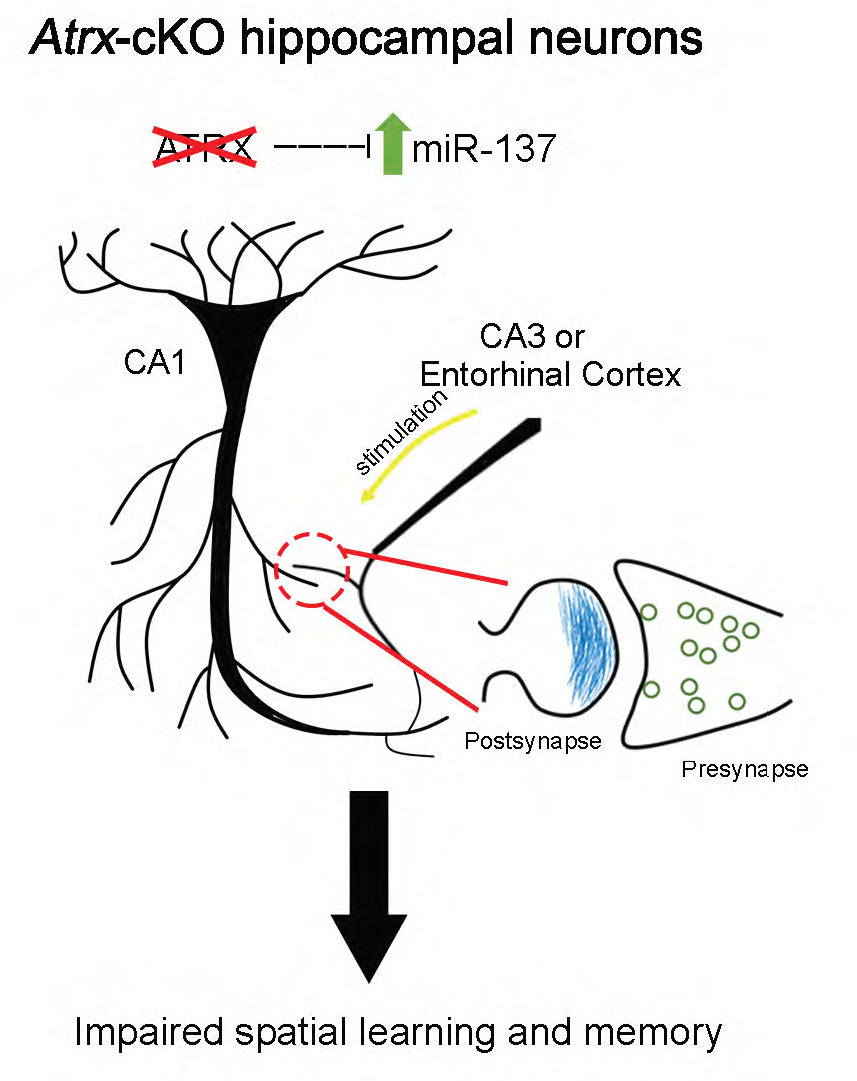
ATRX gene mutations have been identified in syndromic and non-syndromic intellectual disabilities in humans. ATRX is known to maintain genomic stability in neuroprogenitor cells, but its function in differentiated neurons and memory processes remains largely unresolved. Here, we show that the deletion of neuronal Atrx in mice leads to distinct hippocampal structural defects, fewer presynaptic vesicles, and an enlarged postsynaptic area at CA1 apical dendrite-axon junctions. We identify male-specific impairments in long-term contextual memory and in synaptic gene expression, linked to altered miR-137 levels. We show that ATRX directly binds to the miR-137 locus and that the enrichment of the suppressive histone mark H3K27me3 is significantly reduced upon the loss of ATRX. We conclude that the ablation of ATRX in excitatory forebrain neurons leads to sexually dimorphic effects on miR-137 expression and on spatial memory, identifying a potential therapeutic target for neurological defects caused by ATRX dysfunction.
§ Epigenetics · 2020
Atrx Deletion in Neurons Leads to Sexually Dimorphic Dysregulation of miR-137 and Spatial Learning and Memory Deficits
Renee J. Tamming, Vanessa Dumeaux, Yan Jiang,, Sarfraz Shafiq, Luana Langlois, Jacob Ellegood, Lily R. Qiu, Jason P. Lerch, Nathalie G. Bérubé